
The Art of Slow Living: Finding More in Less
Slow living is not a retreat from ambition or a demand for a perfectly calm life. It is a practical way of choosing where your attention, time, and energy belong—and making ordinary days feel more inhabitable.
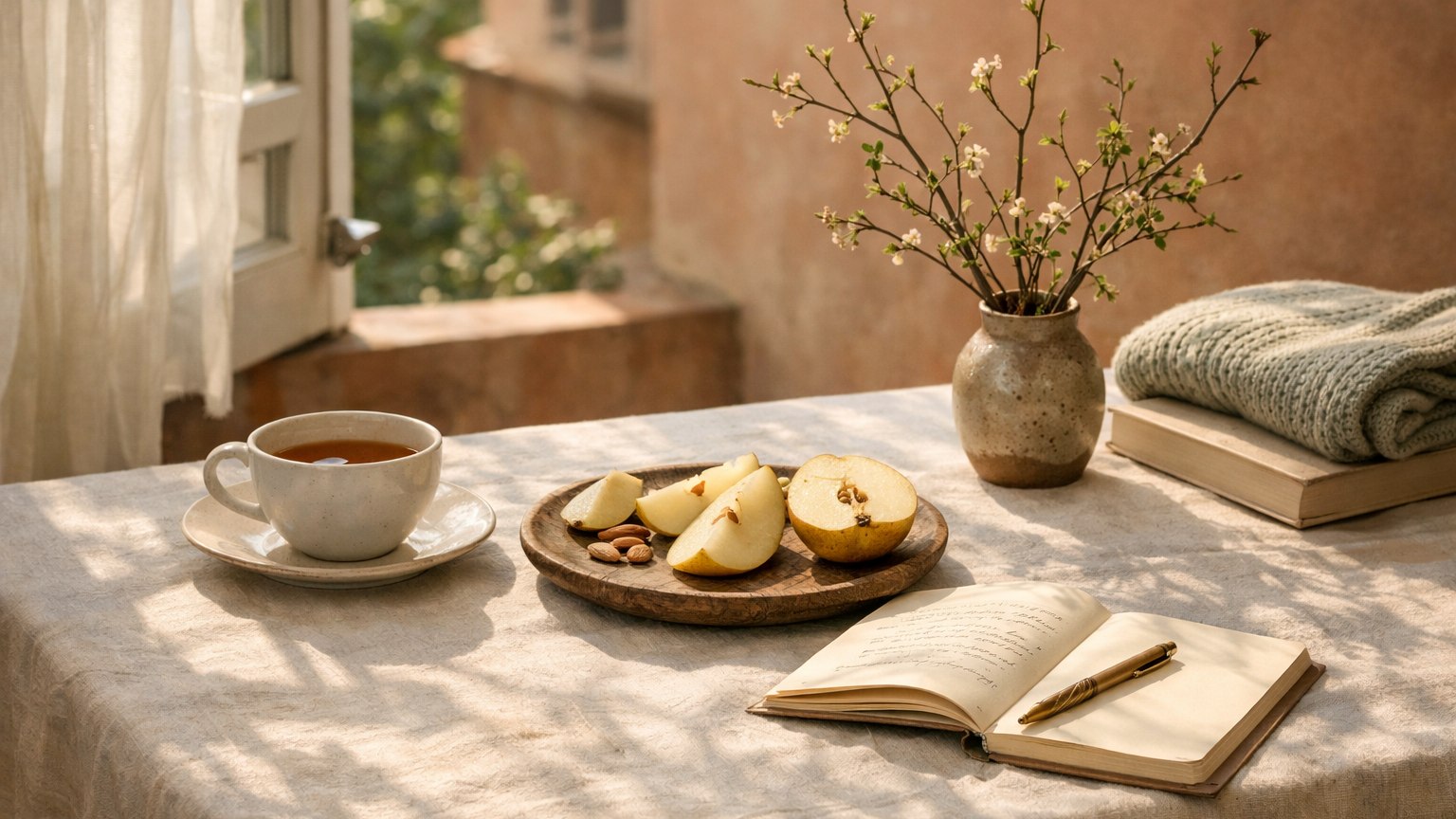
There is a particular kind of tiredness that arrives even after a productive day: the sense that everything was handled, yet very little was actually experienced. Messages were answered, errands completed, meals improvised, tabs closed. But the day itself seems to have passed somewhere just beyond reach.
Slow living begins with an invitation to notice that feeling—not to romanticize a life without deadlines, children, work, caregiving, money worries, or ambition, but to question the assumption that every hour should be filled, optimized, documented, or hurried through. It is a way of arranging daily life around attention, sufficiency, and pleasure in what is already here.
The idea has roots in the Slow Food movement, which began in Italy in 1986 and challenged the culture of speed through a more considered relationship with food, local traditions, and enjoyment. Its early manifesto set “tranquil material pleasure” against the frenzy of the fast life. Over time, the word slow has become a useful shorthand for a broader personal question: what would change if we stopped treating speed as proof that life is going well? source source
Slow is not the same as idle
Slow living is sometimes mistaken for doing less at all costs: fewer plans, fewer possessions, fewer goals. Those choices may be part of it, but they are not the whole philosophy. The more useful definition is selective pace. It means deciding which moments deserve your full presence and which commitments no longer earn their place on the calendar.
This distinction matters because more free time, by itself, is not a guarantee of greater contentment. A large study drawing on two American datasets found that very little discretionary time was associated with lower well-being, but that the benefits of additional free time did not rise indefinitely; a sense of purpose in how time is used also mattered. Slow living, then, is not about creating an empty schedule. It is about making room for activities that feel restorative, absorbing, connected, or simply necessary. source
Think of the difference between an unplanned hour spent refreshing a feed and an unplanned hour used to walk without headphones, mend a button, call a sibling, make a pot of soup, read ten pages, or sit on the front step with a cup of tea. Neither needs to be impressive. But one may leave you with a clearer memory of having been there.
Why the modern pace can feel so thin
Much of daily haste is not self-inflicted. Work structures, commutes, care responsibilities, financial pressures, and always-on technology can make spaciousness feel like a luxury. A thoughtful slow-living practice acknowledges these realities rather than prescribing a photogenic escape from them. It asks where a small degree of choice is available: perhaps in the first ten minutes of the morning, the way lunch is eaten, or the boundary around the last hour of the evening.
One place to begin is attention. What we casually call multitasking is often rapid switching between tasks, and psychological research has long shown that this switching carries costs in time, errors, and mental effort—especially when the tasks are complex. Choosing to do one thing at a time is not precious or inefficient. It can be a practical response to a day that keeps asking the mind to restart. source
Try it in ordinary places. When writing an email, close the shopping tab. When cooking, let the podcast wait until the onions are softened and the table is set. When speaking with someone you love, place the phone out of reach rather than face-down beside your hand. These are modest edits, but they make the day feel less like a corridor and more like a series of rooms.
The small architecture of a slower day
A slower life is rarely created by one sweeping reinvention. More often, it is built through repeatable rituals that reduce needless decision-making and give the day a shape. The aim is not to make every routine sacred. It is to identify a few transitions worth protecting.
1. Create a gentler opening
Before allowing the day’s demands to set the tempo, give yourself a short arrival period. Five or ten minutes is enough: open a window, drink water at a table rather than while standing over the sink, stretch, write a short list, or step outside. If your phone is also your alarm, resist making it the first room you enter mentally. The point is not digital purity; it is beginning with your own thoughts before receiving everyone else’s.
2. Put margins around appointments
Back-to-back scheduling turns even enjoyable plans into a relay race. When possible, leave a small buffer before and after a meeting, school pickup, class, or social engagement. A ten-minute margin can absorb a delayed train, a long checkout line, or the simple human need to pause. It can also prevent one late moment from becoming an evening of irritation.
3. Make one daily task deliberately analogue
Slow living becomes tangible when it has a physical form. Write the grocery list on paper. Visit a market instead of adding another delivery to the queue. Read a printed magazine at lunch. Chop vegetables rather than ordering by reflex once or twice a week. The goal is not nostalgia or moral superiority; it is to choose an activity with a beginning, middle, and end that your hands can understand.
4. Eat at least one meal without multitasking
The table is a particularly useful laboratory for a slower pace. It does not require elaborate cooking. Toast with eggs, leftover rice with vegetables, or a sandwich arranged on a plate can be enough. Sit down, use a real glass, and leave the laptop closed for the length of the meal. Slow Food’s language of pleasure and attention remains helpful here: food can be nourishment, but it can also be an occasion to notice taste, season, effort, and company. source
5. Give the evening a clear edge
Ending the day gradually is one of slow living’s least glamorous and most useful habits. The CDC recommends consistent sleep and wake times and suggests turning off electronic devices at least 30 minutes before bed as part of healthier sleep habits. A simple wind-down cue—a lamp instead of overhead lighting, tomorrow’s clothes laid out, a shower, a few pages of a book—can signal that the day no longer needs to be managed. Persistent sleep problems deserve discussion with a healthcare professional rather than a lifestyle workaround. source
How to choose less without making life smaller
“Less” is most meaningful when it removes friction rather than joy. It may mean fewer subscriptions you barely use, fewer clothes that require persuasion each morning, fewer social plans accepted out of guilt, or fewer purchases that create another item to store, clean, repair, and eventually discard. It may also mean fewer expectations that a weekend must be maximally memorable.
But a slower life can be rich with detail. Buy flowers occasionally from the grocery store. Learn three dependable meals. Keep a running list of nearby places you mean to visit—a library exhibit, independent cinema, park, bakery, neighborhood street you have never walked. Invite one friend for a simple supper rather than waiting until you can host flawlessly. Depth often comes from returning: to a familiar café, a recurring walk, a beloved recipe, a conversation allowed to wander.
Slow living is not a performance of calm. It is the quiet practice of giving your real life enough room to be noticed.
A realistic way to begin this week
If a complete reset sounds exhausting, do not attempt one. Choose a single experiment and keep it specific for seven days.
- Take a ten-minute phone-free walk after lunch.
- Protect one evening from errands, streaming, and social obligations.
- Cook one familiar meal slowly enough to sit down for it.
- Turn off nonessential notifications and check messages at chosen intervals.
- Leave fifteen minutes of blank space before one regular commitment.
- Replace one convenience purchase with something repaired, borrowed, made, or simply skipped.
At the end of the week, ask not, “Did I become a slower person?” Ask, “Which change made my life feel more like mine?” Keep that one. Let the rest go. The discipline of slow living is not rigidity; it is discernment.
There will still be rushed mornings, packed seasons, and days when dinner is eaten from a container in the car. A slower life does not erase those realities. What it offers is a counterweight: a way to remember that attention is not an infinite resource, that enough can be a generous word, and that an ordinary day can become more satisfying when we stop asking it to be faster than human.
 The 30-Minute Household Desk: A Weekly Ritual for Bills, Paperwork and Peace of Mind
 The Household Paper Reset: A Calm, Secure System for Bills, Records and Everyday Life